October 08, 2026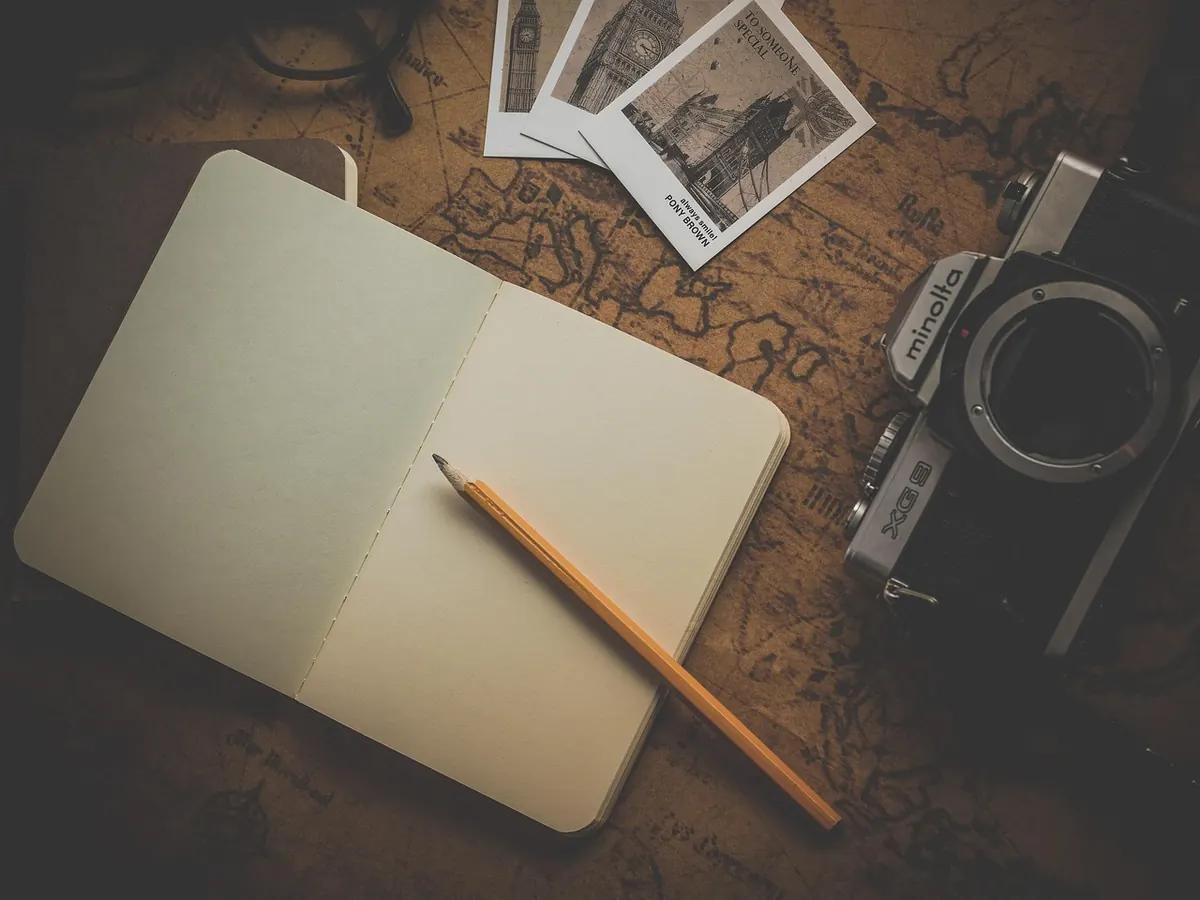
Most travel journals begin at a departure gate. They don't have to. What makes a page of travel writing worth reading is not the distance covered but the quality of attention: the smell of a bakery at seven in the morning, the man who feeds the pigeons in the same order every day, the way a street changes when the shops shut. You can find all of that within walking distance of your kettle.
What follows is a way of working — how to choose where to go, what to record, and how to keep the habit alive when nobody is waiting for a postcard.
Why your hometown counts as travel
You have visited your town. You have not explored it. Those are different activities. Most of us move through the same twenty or thirty places: the route to work, the supermarket, the park with the good gate, a friend's kitchen. The rest — the lane behind the retail park, the footpath that starts where the houses stop, the churchyard with the yew tree older than the church beside it — stays as unknown as a village you have never heard of.
A travel diary gives you permission to be a beginner at home. Nobody expects you to know which way the river runs. Nobody minds if you stop and read a plaque you have passed a thousand times.
Adopt a traveller's eyes
Travellers notice things because everything is new and slightly wrong. Bread tastes different. The traffic lights are in the oddest place. You can borrow that alertness deliberately, for an hour at a time.
Three questions do most of the work:
- What would I notice here if I had arrived by train this morning?
- What do the people who live here queue for?
- What would I tell a friend to look at, and what would I warn them about?
Comparison is the real tool. Not with other countries, necessarily — with other hours. Your high street at eight in the morning and your high street at eight in the evening are two different places wearing the same name. Write both.
Choose a route, not a destination
Travelling at home works better when you set a line to follow rather than an attraction to reach. A route gives you a beginning, a middle and an end, which is most of what an entry needs.
Walk one street from end to end
Pick a road you usually drive. Start where it starts. Note where the terraces become semis, where the shopfronts stop, where the pavement runs out. That is a genuine journey; it simply happens to be a kilometre and a half long.
Follow water, rails or a wall
Canals, rivers, disused railway lines and old boundary walls cut through towns in ways that roads do not. Follow one until it stops being convenient, then turn back and write up what you saw on the way.
Take the last bus
Ride a route to its terminus in daylight and walk back along the same road for an hour. Or ride at dusk and write about the passengers instead. Buses are the cheapest travel research there is.
What to write down
Entries go flat when they list what you did. They come alive when they record what it was like. Aim for a handful of specific details rather than a summary of the afternoon.
- One thing you had never noticed before, however ordinary.
- Three sounds, or the absence of them.
- The exact words of a conversation — the shopkeeper's remark about the weather, the child's question on the bus.
- Something that irritated you. Honesty reads better than enthusiasm.
- A smell you cannot quite name, and what it reminds you of.
- One recommendation for a visitor, and one warning.
- What the place would look like at a different hour or in a different season.
Date every entry and put the place at the top, the way you would in a journal kept abroad: Wednesday 14 May, Lock 4 to the water tower, warm, wind from the west. Weather is not padding. It anchors memory better than almost anything else you can write in the margin.
Small rituals that keep it going
Nobody keeps a diary because they have decided to become the sort of person who keeps a diary. They keep it because the habit is small enough to survive a bad week.
Carry the notebook and write in the moment, even badly — one line about the wet bench, the man arguing with the parking meter. Then give yourself ten minutes at home to expand it while the details are still sharp. Photographs can help, but treat them as prompts rather than a substitute: a picture of a gate tells you what it looked like, not that it stuck in your ribs.
Set a repeating appointment. Saturday morning, one hour, one direction. If you miss it, do not try to catch up. A diary with gaps is normal, and the gaps themselves become interesting later.
Keep the physical bits, too. A bus ticket, a leaf, the receipt from a café you would never otherwise have tried. Tape them in. It makes the book feel like something you carried rather than something you typed.
One practical note: if your route takes you somewhere quiet at dusk, tell someone where you are going and when you expect to be back. A traveller's caution applies at home as well.
What would I notice here if I had arrived this morning, knowing nothing?
Your first local trip
This week, choose one afternoon. Put on comfortable shoes and pick a route with a clear start and finish. Walk it slowly for forty minutes. Stop once, properly, and stand still for two minutes without looking at your phone. Then go home and write a hundred and fifty words under a heading that names the date and the place.
That is a travel diary entry. Do it four or five times and you will have something better than a holiday scrapbook: a portrait of where you actually live, seen properly, by you. You will also never be short of somewhere to travel on a rainy Sunday again.
Photo: DariuszSankowski / Pixabay